Your subscription could not be saved. Please try again.
Your subscription has been successful.
How Many Genders Are There? The Powerful Truth Explained Clearly
How many genders are there? This is one of the most searched — and often misunderstood — questions in modern discussions about identity. For many years, society operated under the assumption that there were only two genders: male and female. However, as our understanding of gender has evolved, it has become clear that the answer is more complex than a simple number.
In this guide, we’ll explore how many genders are there from biological, social, cultural, and identity perspectives — separating facts from confusion and helping you understand the full picture.
While many cultures historically recognized two genders, modern gender theory and lived human experience show that gender exists on a spectrum. That means gender isn’t limited to just “man” and “woman.”
So when someone asks, “how many genders are there?” the answer depends on whether you’re asking from a biological, social, or identity standpoint.
Biological sex is typically categorized as male or female based on anatomy, chromosomes, and reproductive systems. However, even biologically, it’s not strictly binary. Intersex individuals are born with physical characteristics that don’t fit typical definitions of male or female bodies.
This alone complicates the idea that there are only two biological categories.
Gender Identity
Gender identity refers to a person’s internal sense of being male, female, both, neither, or something else entirely. This is where the spectrum becomes clear.
When asking “how many genders are there,” most people are referring to gender identity — not biological sex.
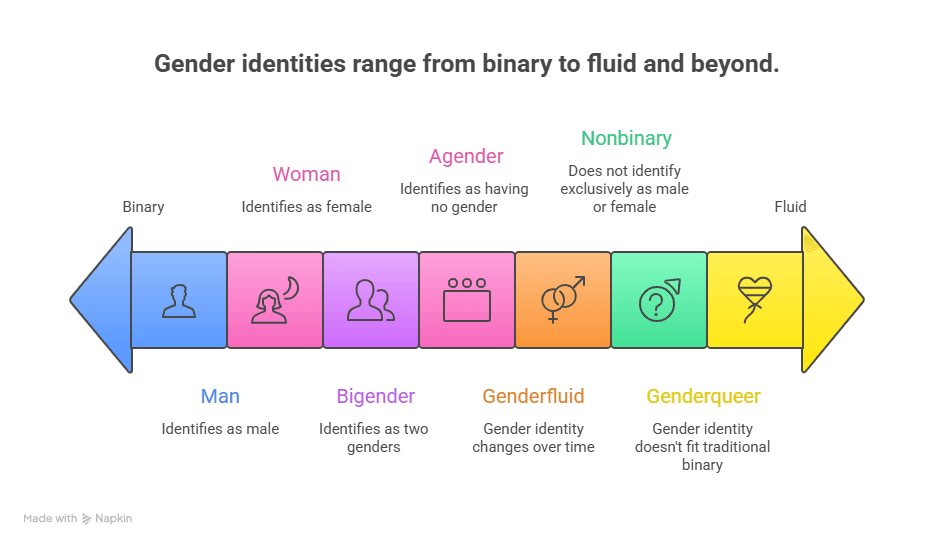
Gender identities range from binary to fluid and beyond.
Commonly Recognized Gender Identities
There is no universal list, but here are some widely recognized gender identities:
Man
Someone who identifies as male.
Woman
Someone who identifies as female.
Nonbinary
A person who does not identify exclusively as male or female.
Genderfluid
Someone whose gender identity changes over time.
Agender
A person who identifies as having no gender.
Bigender
Someone who identifies as two genders, either simultaneously or shifting between them.
Genderqueer
An umbrella term for gender identities that don’t fit traditional binary definitions.
And this is not a complete list. New terms continue to emerge as people find language that better describes their lived experience.
Cultural Perspectives on Gender
Indigenous and Historical Recognition
Long before modern debates, many cultures recognized more than two genders.
Some Indigenous North American communities recognize Two-Spirit identities.
In parts of South Asia, Hijra communities have existed for centuries.
In Samoa, the Fa’afafine represent a recognized third gender.
These examples show that the idea of more than two genders is not new — it simply wasn’t acknowledged in Western mainstream culture for a long time.
Why the Question “How Many Genders Are There?” Is Complex
Language Evolves
As society evolves, language evolves too. More people are discovering words that better describe how they experience themselves. That doesn’t mean gender identities are “made up” — it means people are finding vocabulary that fits their reality.
Gender Is a Spectrum
Think of gender like a spectrum rather than two separate boxes. Some people fall near the traditional ends (man or woman), while others exist somewhere in between or outside those categories entirely.
Scientific and Psychological Understanding
Modern psychology recognizes that gender identity is deeply personal and not always aligned with biological sex. Major medical and psychological associations acknowledge nonbinary and transgender identities as valid.
This reinforces that when asking how many genders are there, the answer cannot simply be “two.”
Common Myths About Gender
Myth: There Are Only Two Genders
This oversimplifies both biology and identity. Intersex conditions and nonbinary identities show that reality is more nuanced.
Myth: More Genders Are a Modern Trend
As mentioned earlier, multiple gender identities have existed across cultures for centuries.
Myth: Recognizing More Genders Causes Confusion
In reality, providing language for identity often reduces confusion and helps people feel seen and validated.
How Many Genders Are There Really?
So… How Many Genders Are There Really?
If you want a strict numerical answer, there isn’t one universally agreed upon number.
Some frameworks list three genders. Others list dozens. Some argue that gender is infinite because human identity is deeply personal and cannot be capped at a specific count.
The most accurate answer to “how many genders are there?” is this:
Gender is not limited to two, and the number is not fixed.
Why This Question Matters
This question isn’t just academic. It affects:
Legal recognition
Healthcare access
Mental health support
Social acceptance
Understanding gender diversity helps create safer, more inclusive communities for everyone.
Final Thoughts
The conversation around how many genders are there continues to evolve. What remains clear is that human identity is diverse, complex, and deeply personal. While traditional frameworks focused on two genders, modern understanding — supported by cultural history and psychological research — shows that gender exists on a spectrum.
Rather than focusing solely on counting genders, a more helpful approach is recognizing and respecting how individuals identify themselves. That respect is what truly creates clarity in today’s world.