Your subscription could not be saved. Please try again.
Your subscription has been successful.
What Is Cisgender? The Clear and Essential Guide Explained
The question “what is cisgender” has become increasingly common as conversations about gender identity grow worldwide. Understanding this term is important for respectful communication and for gaining a deeper understanding of gender diversity.
Simply put, cisgender describes someone whose gender identity matches the sex they were assigned at birth. While the word may seem new to many people, the concept behind it is straightforward and helps create language that accurately describes different gender experiences.
The term cisgender refers to individuals whose gender identity aligns with the sex they were assigned at birth.
For example:
A person assigned female at birth who identifies as a woman is cisgender.
A person assigned male at birth who identifies as a man is cisgender.
Understanding what cisgender is becomes easier when comparing it to the term transgender, which describes individuals whose gender identity differs from the sex assigned at birth.
The Meaning of the Prefix “Cis”
Where the Word Cisgender Comes From
The Meaning of the Prefix “Cis”
The prefix “cis” comes from Latin and means “on the same side.” In contrast, the prefix “trans” means “across” or “on the other side.”
So when people ask what is cisgender, the answer is rooted in this linguistic distinction: cisgender means your gender identity stays on the same side as your birth assignment.
Why the Term Was Introduced
The term was introduced to create neutral language when discussing gender identity. Instead of labeling only transgender individuals, it provides a term for people whose gender identity aligns with their assigned sex.
Cisgender vs. Transgender
Understanding the Difference
When discussing what is cisgender, it helps to understand how it differs from transgender identity.
Cisgender: Gender identity matches assigned sex at birth.
Transgender: Gender identity differs from assigned sex at birth.
Neither term implies anything about personality, behavior, or sexual orientation. They simply describe gender identity.
Cisgender and Sexual Orientation
They Are Not the Same Thing
A common misunderstanding when asking what is cisgender is confusing gender identity with sexual orientation.
Gender identity refers to how someone identifies internally as male, female, both, neither, or somewhere along the gender spectrum.
Sexual orientation refers to who someone is attracted to.
Understanding what is cisgender helps create more respectful and inclusive conversations about gender identity.
Using accurate terminology helps people discuss identity without making assumptions or excluding experiences.
Reducing Misunderstandings
Many debates around gender identity stem from confusion about terminology. Learning what cisgender means helps reduce misunderstandings and encourages more productive dialogue.
Understanding Cisgender
Common Myths About Cisgender
Myth: Cisgender Is a New Concept
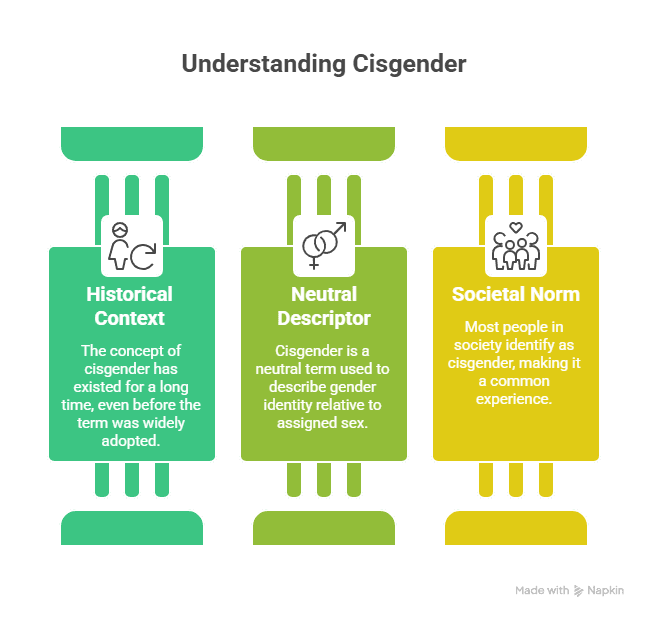
While the word itself became more widely used in recent decades, the concept of describing gender identity relative to assigned sex has existed much longer.
Myth: Cisgender Is an Insult
The term is not intended as criticism or insult. It is simply a neutral descriptor, just like terms such as heterosexual or left-handed.
Myth: Only Certain People Are Cisgender
Most people in society identify as cisgender. The term simply gives a name to that experience.
Cisgender in Everyday Life
Representation in Society
Cisgender individuals make up the majority of the global population. As a result, many social systems, traditions, and expectations are built around cisgender experiences.
Learning About Gender Diversity
Understanding what is cisgender is often a first step toward understanding broader gender diversity and how different identities fit within society.
Learning About Gender Diversity
How Language Around Gender Continues to Evolve
Growing Awareness
As discussions about identity expand, language evolves to help people describe their experiences more accurately.
Importance of Open Dialogue
Keeping an open mind and learning about terms like cisgender encourages empathy and understanding across communities.
Final Thoughts
The answer to the question “what is cisgender” is simple: it describes someone whose gender identity matches the sex they were assigned at birth. While the term may be unfamiliar to some, it plays an important role in conversations about gender identity.
Understanding this term helps create clearer communication and fosters respectful discussions about identity, diversity, and human experience.